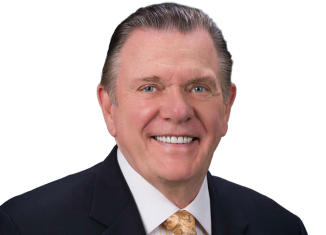
Daniel Di Martino: “We Are Stealing Our Future To Pay For Our Present”
Listen to the full interview below:
Full transcript:
Guy Benson: Well, joining us now is Daniel DiMartino. He’s a fellow at the Manhattan Institute, and he’s on the Board of Advisors for the Young America’s Foundation Center for Entrepreneurship and Free Enterprise. He is a Venezuelan immigrant, along with his family. He is a very able spokesperson for capitalism and someone who warns against socialism for very, very personal reasons.
Daniel, great to have you back.
Daniel DiMartino: Thank you for having me.
Guy Benson: Before we get into some of the socialism stuff and that seemingly rising tide in this country and our politics, I do want to ask you about this video that went fairly viral a couple of days ago.
You were in some kind of a debate against two young guys who are leftists, and then you and another young conservative were having this discussion going back and forth. What caught my attention was that you were able to basically get one of the lefties to label Senator Susan Collins from Maine–which is, I think, arguably, maybe even inarguably, the most moderate senator in that chamber–a radical.
You were talking about actual radicals on the ballot who believe insane, very crazy things, and then you were sort of mixing it up back and forth and got him to accuse Susan Collins of being a radical. Just tell us about that whole back-and-forth.
Daniel DiMartino: Yeah, so this was in a Jubilee debate. It was two against two: two young conservatives against two young liberals. What was shocking to me is their inability to concede the point that there are any single normal, even moderate Republicans.
Look, I think Susan Collins is actually way too moderate for my preferences. She voted to keep Obamacare, but she also voted for Kavanaugh for the Supreme Court. She votes in the middle. By any measure, she’s in the middle of the U.S. Senate when it comes to ideology.
And she’s facing an actual democratic socialist, somebody who believes not in capitalism but in socialism, who wants to nationalize companies, and who has a really bad personal background, too: Troy Jackson.
So they can’t even concede that. They even endorsed him in other parts of that debate. They said he’s normal.
I actually think, Guy, that this is what happens when you work for a company that’s contracted by the DNC. You really can’t say anything bad.
Guy Benson: By contract. I mean, that’s possible, right? And they could just be blind partisans as well, where anyone who’s on your side of the tent–even if they’re basically a communist or sitting at the intersection of socialism and Islamism–you can’t call them radical. You can’t concede a single point.
And when your brain is that twisted into a pretzel, you can bring yourself to say something out loud like, “Susan Collins is a radical,” which is just completely laughable, right?
I wish you were more conservative on any number of things. I also am realistic, and I realize she’s from New England, and it’s a blue state in many ways, and she’s got her own brand, and she is very, very consistent.
But if we’re calling Susan Collins a radical, or radical-adjacent, or whatever it is–
Daniel DiMartino: Then we’re all really extremists.
Guy Benson: Right.
Daniel DiMartino: That’s what happened in that debate. It’s a shame, because I actually think it would be good if there were more people like Susan Collins and fewer extremists–factual extremists–in the U.S. Senate on the left.
Guy Benson: Of course, I agree with that.
Now, having scored that, I think, point in the debate, forcing them to make that ludicrous assertion, that clip made the rounds on social media. You were then the subject of some fairly ugly attacks about your accent and people questioning why you haven’t been deported, whether they thought they were being cute or something like that.
I don’t know, but I know that kind of rhetoric they would immediately denounce as racist on the right, but these were lefties coming after you. I guess because you were doing a nice job in the debate and you have an accent, you are an immigrant, and so the calls for deportation were starting to make the rounds as well. That was pretty strange.
Daniel DiMartino: Well, you know, I’m not a stranger to that. I’ve gotten that a lot from both sides. I think the left thinks they get a pass on it, right? Like, “Oh, it’s not racist if the left says that.”
So they get to report people they disagree with. But then Trump is evil for deporting criminals.
It’s funny because the same guy who said that, Tim Miller, tries to say he’s better than everybody else and does fundraisers for Haitian immigrants who are being deported. So it’s like, you know, the Haitians are all right, but not the Venezuelans? I’m sorry. We have to go.
Guy Benson: Let’s talk about the reason why your family came to this country in the first place. Give us, for the audience members who are unfamiliar with your background, the relatively short summary of what was done by the socialists in your country that forced your family out of there.
Daniel DiMartino: Well, what I would tell people is that Venezuela was really a good, normal country. Venezuela was a place where I had a car, where I went to a normal school, where I had friends, where you went to parties, and you had water and food.
And then suddenly, you had to really search for food and line up. Then there was no electricity for many hours and no water for many days. You had to bring water up the stairs, five floors, in order to get up because there was no elevator working because of the power outages.
Life really went from first world to third world because the socialist regime that took over 27 years ago took people’s companies, put in price controls and rent control, spent so much money, hired so many government workers, and everybody began working for the government, earning so little and depending on them for their check.
And then they began rigging the elections. That’s what destroyed our country, and that is what the DSA is proposing here, too.
Guy Benson: That’s, I think, such a key point, because my guess is that a lot of the people, especially young people, who are flirting with socialism or are embracing it entirely and are rejecting the American model, they blame capitalism for every social ill.
And they have sort of fallen under the spell, into the thrall, of these politicians who make these promises that are very familiar–promises that always get broken–and yet they are, I guess, superficially appealing to some people.
If you were to confront them with examples of societies, cultures, and countries that were taken over by this ideology, sometimes, like in Venezuela’s case, at first through elections, and then elections are, at that point, watered down, corrupted, stolen, or ended altogether, what young Americans would say is, “Well, that’s different.”
You speak at a lot of different college campuses. You tell your story. You bring these concrete examples, trying to wave a red flag: “Watch out. This is not what you think it is.”
My general sense of it is a lot of the tangentially attached socialists–not the hardcore, sort of wild-eyed true believers, but a lot of people who’ve been caught up in this and find it romantic and maybe like some sort of viable path forward–they would say, “Oh, well, you know, maybe those bad things happen in other countries. But the United States is different.”
And that sort of alarmism–“All we’re asking for is some basic human rights and some basic equality”–that would be the pushback, I would imagine.
How would you deal with that critique?
Daniel DiMartino: Well, what I would say is: If you implement everything that Venezuela did and just change the people–you don’t have the drug traffickers in charge, but good people–that’s how it was at the beginning of Hugo Chávez’s government.
And all the good people were fired and eaten up by the bad people who were willing to use force. That’s why a lot of socialists became disappointed at the beginning of the Chávez years. His ministers quit. There were so many scandals, and then all the people were pushed out. That’s what always happens.
And even if you don’t believe in that version of socialism, you say, “Well, I want what’s in Norway, Denmark, Sweden, and Iceland.”
In Norway, Denmark, Sweden, and Iceland, all of those countries have lower or even zero inheritance taxation. They have lower corporate taxes. The top 1% pay the same income tax rate as the rich pay in New York City–not in Texas, but certainly New York City, where they already have high taxes.
And they fund their governments by putting 20% and 25% sales taxes on people, not taxing the rich, but taxing everyone. That is how those countries work.
Guy Benson: Is that something that just kind of gets missed in our whole debate?
I’ve talked about it a bit recently with some of these candidates talking about universal health care, Medicare for All, which is basically estimated–even by left-leaning outlets–to cost $30 to $40 trillion over the span of a decade. So let’s call it $3.5 trillion a year, thereabouts.
In perpetuity, that’s probably a low estimate. Huge amount of money on top of what we’re already spending. We’re already at $2 trillion in the red this year alone.
And in order to cover that cost, the amount of tax increases across the board on everyone would be staggering.
I think maybe their messaging has penetrated, Daniel, that it’s just the corporations, it’s just the millionaires and billionaires, it’s not going to be you. “Don’t worry, someone else will foot the bill.”
I think a lot of these people probably believe that, but it just is not even close to mathematically true.
Daniel DiMartino: It’s really just about math, right? Like, if we took all the wealth–wealth, not income–of all billionaires in the United States today, we wouldn’t be able to pay for Medicare for a single year.
And then we can only do that once. So they really can’t only go after–
Guy Benson: Rich people. They have to go after everyone. I just want to make sure people heard that.
If you confiscated the entire net worth of all the billionaires in America, that would not cover one year of so-called Medicare for All. And then you would have all the other years stretching forever to pay for, with the billionaires tapped out to zero.
That’s the math.
Daniel DiMartino: That’s right. That’s just the math, assuming we could even confiscate their wealth, which they would flee before we did that. It’s impossible mathematically.
We already spend in government health care in America more than the European countries spend covering their entire population.
So we can’t even afford Medicaid and Medicare for the elderly. How can they expect we afford the rest?
We need to reform the system we have. We actually need to shrink it. Why should Bill Gates be getting Medicare? Why should 20% of the population be on Medicaid? This should be for the poor, not for the bottom 20%. That’s way too many people.
And we really need to tighten our belts. Perhaps we do need to make some changes in taxes, but just to shrink the deficit, not to expand government that we can’t even afford.
Guy Benson: Why do you think it is? Because there are two, I think, very significant–I’ll call them misconceptions. I think a lot of it’s based on lies and consistent messaging that is deliberately untrue.
But if you were to talk to the average supporter of Zohran Mamdani, some 23-year-old in New York City, or go down the list, Katie Wilson out in Seattle, they would believe that, to your point, the U.S. government spends almost nothing on these social services, and we were just starving.
The people were starving. The government was starving us with this cruel system, and we spent all of our money on defense or the military and Israel, right?
They believe they just take a bunch of the taxpayer money that comes in, give it to our military, give it to Israel, and that’s their vision of what the spending pie looks like in an average year, without acknowledging the gigantic social welfare programs that are already in place that, by the way, are going insolvent right now, are going bankrupt.
They’re not aware of that. They don’t believe–
Daniel DiMartino: The truth is, the majority of our government’s spending goes to pay for people above age 65. There’s also Social Security, Medicare, and other benefits that they get. That’s where the majority of the federal government’s money goes to.
The U.S. government is essentially an insurance company that takes from young workers and gives to old people. That’s what it’s become.
We have the most generous pension system for the elderly in the world in terms of how much money they get, adjusted for purchasing power.
We should, in fact, reduce the growth of Social Security and Medicare. That’s not popular, which is why politicians on the left and the right don’t talk about it, because it turns out that the elderly are the biggest voting bloc, because they turn out, unlike the young.
And so that’s a sad reality. We’re still borrowing from our future to pay for our present.
Guy Benson: Did I see online that you were at that data centers party in D.C. over the weekend?
Daniel DiMartino: Yes. It was kind of like a last-minute thing, and I was very happy. It honestly was a blast.
Guy Benson: All right, so tell us about this, because I had a few friends who were there.
There’s been a lot of anger and hysteria. I think some of the concerns are well-grounded and well-founded, but some of this stuff, to me, is just totally over the top.
I think it’s definitely–we know some of it is being stoked by the Chinese Communist Party. This is sort of like a rebellion against that. Let’s have a party in favor of data centers, in favor of what it takes to give Americans what they want, which is unlimited data, despite some of, I think, understandable misgivings about AI.
Tell us about the party and the message and that debate, which seems to be quite warped and often irrational right now.
Daniel DiMartino: Yeah, well, it was packed. Many more people than I thought would show up. Great music. I gave a short speech.
I talked about how this is really not just about economics, but it is about great-power competition with China.
The truth is, the data centers and technology will get built. The question is whether it gets built here or abroad. And if it gets built in China, they’re going to be ahead of us technologically, and that is actually a security threat for us in the case of a war that we cannot afford to lose.
We need to deter that from happening so that we maintain peace.
So that is my argument on the economic side. Look, people are very happy to say, “We need to prop up the steel mills,” and they’re sad that manufacturing has gone down. But I can assure you, you would prefer to live next to a data center than a steel mill.
I can assure you they’re not as good of neighbors, with the pollution and the noise, relative to a data center.
So if you’re for reindustrialization, if you are for American jobs, if you’re for greater tax revenue for your town, data centers are really a no-brainer.
It’s true that they demand a lot of electricity, but we should also be for more electricity production–energy abundance.
Democrat states are doing it really badly with all the green mandates, and it’s working really well in places like Virginia, you know, near where we are, in Texas.
Guy Benson: Why do you think those arguments aren’t penetrating right now?
Daniel DiMartino: You know, I think people have a fear of what’s new and progress.
This isn’t new with every technology, right? People were against cars at the beginning, and that happens. It’s a natural human reaction.
I think there’s also, on the conservative side, a fear that the data centers are being used for surveillance and that that helps with surveillance. They’re connected with the Flock camera issue. It’s all getting really mixed up.
There’s a lot of distrust toward the tech companies because they’re doing really horrible messaging. The owners of the tech companies aren’t necessarily socially conservative people who seem to have great plans. They actually sound very dystopian and scary to me as well.
And so I think that’s the reason.
Guy Benson: Yeah, no, I think that’s true.
And then you’ve got–you mentioned Abdul El-Sayed earlier in our conversation. He was asked about the Chinese threat, and he was like, “Oh, that’s just a boogeyman.” Basically, it’s kind of all fear-mongering and overblown.
And I think that is absolutely wrong and pretty breathtaking that he would say that.
But that’s where the debate seems to be right now. And it’s a debate that requires engagement, which is why we were eager to have you on the show today.
Daniel DiMartino at the Manhattan Institute. He’s an economist and a Venezuelan immigrant as well.
Daniel, thanks so much.
Daniel DiMartino: Thank you, guys.